NFL Football Betting: The Books Took A Record $595 Million In One Week And Kept Almost None Of It
Everything you need to know about how sportsbooks actually make money, how anyone can tell the pros from the public, and why the 2026 season started so badly for the house.
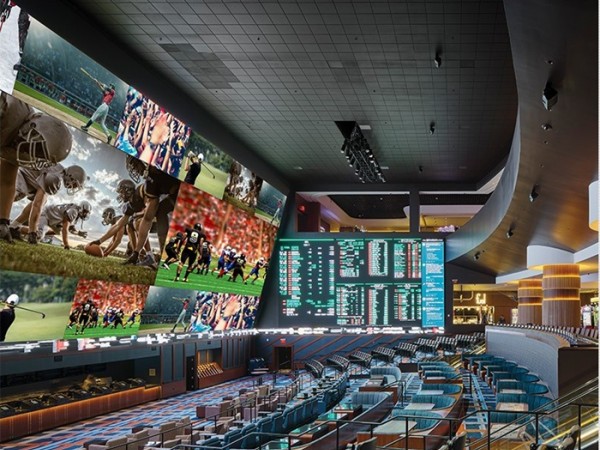
Circa Resort & Casino
Let's start with the word you see in every betting article and almost nobody bothers to define.
What "handle" means
Handle is the total amount of money people bet. That's it.
Think of a pizza shop. Handle is every dollar that comes through the register. It is not profit. The shop still has to pay for flour, cheese, rent and staff.
A sportsbook works the same way. If ten people each bet $100 on a game, the handle is $1,000. But the book has to pay the winners. Whatever's left over after that is what the book gets to work with.
That leftover has a name: the hold.
Hold is what's left after paying winners, divided by handle. If a book takes $1,000 in bets and has $50 left after paying everybody out, that's a 5 percent hold.
This is the single most important number in the entire industry, and it's the one nobody puts in headlines. Handle makes for a big exciting number. Hold is where the business actually lives.
Important: hold is NOT profit
This trips up almost everybody, so let's be precise.
Hold is revenue, not profit. It's the money left after paying winning bettors — and before the sportsbook pays a single one of its own bills.
Out of that leftover still has to come:
- State taxes. In New York these are brutal: 51 percent of revenue goes to the state.
- Federal excise tax on handle.
- Promotions and free bets given to customers.
- Marketing — the ads you cannot escape in September.
- Staff, technology, data rights, licensing fees.
So when we say New York's books "kept" $17 million in Week 1, understand what that really means. Roughly $8.6 million of it went straight to New York State in tax before the books paid for anything else. Whatever actual profit existed came out of what was left.
One more wrinkle worth knowing: states don't even define "revenue" the same way. Pennsylvania and New Jersey report gross revenue. Michigan reports "adjusted gross receipts," which is after promotional credits are subtracted. So a 7.3 percent hold in Michigan and a 10.1 percent hold in Pennsylvania are not measuring quite the same thing — something to remember any time you see hold figures compared across states.
Now here's what happened in Week 1
New York is the biggest legal betting state in America, and it's the only one that reports its numbers every week instead of every month. So it's our window into the whole industry.
Week 1 of the 2026 NFL season, New York sportsbooks:
- Handle: $594,594,256. A record. Up 12.7 percent from last year.
- Revenue (what was left after paying winners): $16,963,049. Down 44.5 percent.
- Hold: 2.85 percent.
Read those together. Record money came in. Revenue fell almost in half.
To see how bad 2.85 percent is, you need something to compare it to. Since New York launched in January 2022, its books have held 9.10 percent over the long run. So in Week 1 they kept less than a third of what they normally keep.
It was the third-worst NFL week New York has ever had. Not one single sportsbook in the state held even 6 percent.
Here's how each one did:
| FanDuel | $224.5M | $8.3M | 3.7% |
| DraftKings | $216.7M | $4.7M | 2.2% |
| Fanatics | $60.5M | $642,600 | 1.1% |
| Caesars | $36.3M | $1.1M | about 3.0% |
| BetMGM | $35.4M | $967,000 | about 2.7% |
| BetRivers | $10.4M | $608,100 | 5.8% |
| theScore Bet | $7.5M | $420,200 | 5.6% |
Click a column to sort. Click again to reverse it, and once more to go back to the original order.
Fanatics took in sixty million dollars and kept six hundred grand. That is a rounding error — and remember, half of even that goes to the state.
Why it happened: the three things that hurt a book at once
A sportsbook doesn't get wrecked because a lot of people bet. It gets wrecked because a lot of people bet the same things and those things all win together.
In Week 1, three things happened at the same time:
- Favorites won. The popular teams covered.
- Overs cashed. Week 1 averaged 49.4 points per game, a shootout week.
- Touchdown scorers hit. Those are the most popular prop bets in the sport.
ESPN called it a "bettor-friendly trifecta," and that's exactly right. Because here's the thing — those three are the same three things people stuff into parlays.
Parlays are the whole business. Seriously.
A parlay is when you tie several bets together. All of them have to win or you get nothing. The payout is big, which is why people love them.
They are also where sportsbooks make almost all their money. The numbers are genuinely startling:
- A normal single bet on a point spread holds about 4.75 percent. The book keeps under a nickel of every dollar.
- Parlays hold in the high teens, roughly four times as much.
- A five-leg same-game parlay carries a theoretical house edge of over 35 percent.
And look at how much of the business they now are:
- Parlays are about one-third of all the money bet — 33 percent of handle.
- Parlays are about two-thirds of all the money the books keep — 62 to 63 percent of revenue.
One-third of the money in, two-thirds of the money kept. If you want to understand modern sportsbooks in one line, that's it. The straight bet on the Chiefs is barely a business. The eight-leg same-game parlay is the business.
And that's exactly why Week 1 hurt so much. When favorites, overs and touchdown props all hit on the same Sunday, the parlays hit too, and the high-margin product turns into the high-loss product.
Here's a bookmaker explaining it himself
This is the best quote of the season so far. Joey Feazel, Head of Football Trading at Caesars, on Week 2:
The Eagles, Ravens, Bears and Bucs were the most popular moneyline parlay selections, so the book needed at least one significant interruption to the bettors' Sunday plans.
Read that again, because he's admitting something the industry usually dances around.
The book was not "balanced." It wasn't sitting neutral collecting a fee. Everybody had stacked the same four teams into their parlays, which meant Caesars effectively held one giant bet: that at least one of those four would lose.
Baltimore lost outright as an 8.5-point home favorite. Tampa Bay lost outright as an 8.5-point home favorite. Feazel's description of watching it:
The Ravens had the book chilling the sparkling water. The Buccaneers' defeat finally popped the cork.
Adair Horne, a trading manager at BetMGM, summed the day up bluntly:
It was an extremely rough week for the bettors, with five upsets and only seven favorites covering the spread.
And Seamus Magee of BetMGM pointed at where the money actually came from:
The book had a really solid day, particularly the live [in-game] book.
That's in-game betting, wagering while the game is happening. When a favorite collapses after people have already bought in live, the book cleans up.
The myth that books "balance" every game
You've probably heard that sportsbooks don't care who wins — they just take equal money on both sides and collect a fee.
Vegas bookmakers have been on the record saying that's not true for years. These quotes are from a 2022 Las Vegas Review-Journal piece, so they're older, but nothing about the business has changed:
Jay Kornegay, Westgate SuperBook:
In theory, we try to balance the books. But the truth is, you always want to put the book in the best possible position to win.
Nick Bogdanovich, then at Caesars:
That's a fallacy. It never happens that way. The books always have decisions.
Chris Andrews, South Point:
While that's solid in theory and is usually the goal, it's rarely the reality.
Books take positions. They gamble. Some weeks they lose.
Now the big one: how do you know who's a pro and who's the public?
This is the question everybody asks, and the honest answer has two halves — the mechanic, and the catch.
The mechanic: two different numbers
Sportsbooks publish two separate percentages for each game:
- Ticket percentage — what share of the individual bets are on a side. This counts people.
- Money percentage, also called handle percentage — what share of the dollars are on a side. This counts money.
The gap between them is the entire signal.
Say a game shows 80 percent of tickets but only 35 percent of the money on the Cowboys. That means a huge crowd of people made small bets on Dallas, and a much smaller group put much bigger money on the other team.
Lots of little bets is what the public looks like. A few enormous bets is what professional money looks like. So when the two numbers split far apart, you're seeing small money and big money disagree.
If both numbers match — 70 percent of tickets and 70 percent of money — there's no signal at all. That's just a popular team.
The second clue: which way the line moves
The point spread moves as bets come in. Normally it moves toward whichever side the money is on.
When the line moves the opposite way from where most of the tickets are, that's called reverse line movement, and it's the loudest signal in betting. It means the book is more worried about a small amount of money from people it respects than a large pile of money from people it doesn't.
Jeff Stoneback, then director of trading at MGM Resorts, explained the logic perfectly — again, a 2022 quote:
In a perfect world, there'd be equal action on every game. But when professionals get involved, we want to make sure we're on their side.
That's it. Books track every account. They know which customers beat them over time. When one of those accounts bets, the book moves, regardless of how many small bets are stacked on the other side.
The catch — and this part matters
Nobody checks these numbers.
Betting splits are published voluntarily by sportsbooks as marketing. No regulator requires them, audits them, or defines them. There's no standard for what counts or what time window is measured.
Jack Andrews, a professional bettor of more than 20 years, put it about as directly as it can be put:
The sportsbooks that provide these betting splits are the recreational sportsbooks, not the sharp books.
These betting splits...are a ploy to get you to bet more by thinking that these numbers tell a story.
Even better is when those betting splits contradict themselves based on which sportsbook is providing the information.
That last line is not theoretical. We've run into it directly in our own tracking. On Lions-Bills in Week 2, DraftKings' own page showed Buffalo at 81 percent of the money on 78 percent of the tickets — a 3-point gap, meaning no signal whatsoever. Two other outlets showed the same game at 71 percent of money on 26 to 33 percent of tickets — a gap of roughly 40 points, meaning a massive signal.
Same game. Same day. Two completely opposite readings.
Also worth knowing: most "sharp money" reporting is anonymous. A typical article says the writer "spoke with several bookmakers" and then lists plays. No bookmaker is named. Nobody can check it. And the books supplying it benefit from the publicity.
So the honest version is this. The ticket-versus-money gap is a real mechanic and it does describe something true about how books operate. But the published figures are unaudited marketing from the books that lose money to pros, and they disagree with each other. Treat them as a clue, never as a fact.
Week 2: the books got it back
Week 2 flipped completely.
Scoring fell off a cliff, from 49.4 points a game down to 40.4. That's a nine-point drop in seven days. Unders went 9-2 across the first 11 Sunday games. The Vikings beat the Bears 9-3. New England beat Pittsburgh 20-3.
Five underdogs won outright. As Feazel put it:
Underdogs and defenses came out swinging, offenses went quiet, and touchdowns were much harder to locate. This Sunday, the end zone required a reservation.
When scoring dies, parlays die, and the books eat. That's the same mechanic running in reverse.
This isn't just a New York problem
Zoom out to the whole country. The American Gaming Association's numbers for the second quarter of 2026:
- Handle: $38.84 billion, up 7.8 percent
- Revenue: $3.91 billion, down 0.2 percent
- Hold: 10.1 percent, down 81 basis points
That was the first time U.S. sports betting revenue has ever shrunk outside of the pandemic. More money coming in, less money staying.
And here's the part that kills the easy explanation. People assume the books' revenue fell because they were handing out free-bet promos to chase customers. They weren't. Promotional spending actually dropped in 2026, from 3.07 percent of handle down to 2.65 percent, a 13.5 percent cut.
The books spent less and still made less. This is a results-and-product story, not a marketing story.
The competition nobody at the books wants to talk about
Prediction markets — Kalshi, Polymarket — let people trade contracts on game outcomes instead of placing bets. They're growing fast.
But be very careful with the numbers you see, including ones we printed before. Four different sources put Kalshi's NFL Week 1 activity at $983 million, $3 billion, $4.9 billion, and $441 million. They're all measuring different things, and there's no audited standard.
More importantly: exchange "volume" is not the same thing as sportsbook "handle." On an exchange, every trade has a buyer and a seller, and the same contract can be traded over and over before the game ends. Comparing those two numbers side by side is not a fair comparison, and almost nobody makes that clear.
And prediction markets are not "no-vig," which is a claim you'll see constantly. Kalshi charges a fee of 7 percent times price times one-minus-price per contract. That fee is highest on coin-flip games and lowest on heavy favorites, the exact opposite of how a sportsbook's pricing works. One analysis by OddsShopper found that a bettor shopping across multiple sportsbooks got a better price than Kalshi on 23 of 28 NFL Week 1 team prices once the fee was counted. Kalshi's edge is real mostly for people who only use one app, or who bet favorites.
Sportsbooks are still much bigger. Eilers and Krejcik projects regulated books will handle $31.7 billion of NFL action this season, 79 percent, against $8.4 billion for prediction markets, 21 percent.
Still — DraftKings CEO Jason Robins named Kalshi and Polymarket, not FanDuel, as his main competitors on a webinar this week. And he said this:
It's funny because, if you asked me, I would say I'd rather see them stay, but I would also guess that if prediction markets got shut down by the Supreme Court tomorrow, our share price would pop.
That's a CEO admitting his stock would jump if his competitor died, while saying he'd rather keep it around. That sentence contains the entire moment.
One thing we can't tell you yet
We don't have Nevada's numbers, and neither does anyone else.
Nevada reports monthly and runs about five weeks behind. September 2026, the first real NFL month, won't publish until late October. Anyone showing you Vegas football figures for this season right now is making them up.
For context when it does land: in September 2025, Nevada's football win was $32.85 million at a 6.70 percent hold, itself down 41 percent from the year before. So "the books had a rough September" is not brand new in Nevada.
The overall summary
Here's everything above in one place.
Handle is all the money bet. Hold is the small slice left over after winners are paid — and that is revenue, not profit, because taxes, promos, marketing and salaries all still come out of it. A book normally holds around 9 to 10 cents of every dollar, and in New York it hands 51 percent of that straight to the state. In Week 1 of the 2026 NFL season, New York's sportsbooks took a record $595 million and were left with 2.85 cents on the dollar before any of their own costs — their third-worst NFL week ever, with not one book in the state clearing 6 percent. Handle rose 12.7 percent; revenue fell 44.5 percent. Nationally it's the same shape: handle up 7.8 percent in the second quarter of 2026, revenue down 0.2 percent, the first non-pandemic contraction on record.
The reason is parlays. They're a third of the money bet and two-thirds of the money the books keep, because a single spread bet holds under 5 percent while a parlay holds in the high teens. When favorites, overs and touchdown props all hit on the same Sunday — which is exactly what happened in Week 1 — every parlay in the country cashes at once and the highest-margin product becomes the biggest loss. Week 2 flipped it: scoring dropped nine points a game, five underdogs won outright, and the books got their money back. And notably, promo spending actually fell in 2026, so this is not the books buying customers — it's results and product mix.
As for telling the pros from the public: compare the share of tickets to the share of money. A big gap means a crowd of small bets on one side and serious money on the other. If the point spread then moves against the crowd, that's the book siding with the money it respects — the industry has been on record about this for years. But those published split numbers are unaudited marketing put out voluntarily by the recreational books, they are not standardized, and they openly contradict each other — we watched two sources describe the same Lions-Bills game 40 points apart. It's a clue, not a fact.
Bottom line: the books are not printing money right now, and the public isn't beating them either. Both are getting squeezed, the books by results and the public by the vig, while prediction markets grow fast on numbers nobody can verify. Two weeks is a tiny sample and none of this predicts Week 3. Check back in ten weeks.
Sourcing and honesty notes: New York's 51 percent mobile sports betting tax rate on gross gaming revenue is set in state law. New York figures are from NY State Gaming Commission weekly mobile wagering reports, cross-checked across ESPN, Covers, CDC Gaming and InGame — all four agree to the dollar. One small discrepancy: InGame lists BetMGM handle at $35.4M, Covers at $34.5M. National figures are the American Gaming Association's Commercial Gaming Revenue Tracker. Parlay hold and share figures, and the promo-spend decline, are from Closing Line's six-season football dataset. The Michigan and Pennsylvania hold figures are August 2026 monthly reports used only to illustrate that states define revenue differently; they contain no NFL games. Bookmaker quotes from Feazel, Horne and Magee are from FOX Sports' Week 2 betting recap, September 2026. The Kornegay, Bogdanovich, Andrews and Stoneback quotes are from a March 2022 Las Vegas Review-Journal column and are clearly labeled as such — they are not 2026 commentary. The betting-splits critique is Jack Andrews at Unabated. The Kalshi fee analysis is OddsShopper's proprietary work and is attributed to them rather than stated as fact. Prediction market volume figures disagree by a factor of ten across sources and are reported as a range rather than a number. Nevada September 2026 data does not exist yet. Zero preseason data anywhere in this. — datadisrespect.com